One…
We spent Christmas night camped out in style on the Serengeti Plain.  Our Tanzania safari was incredible, and did we see the big 5?
Oh yeah!...


 And then some...!


 This is for you, Cyn
What made it all really special is that we were able to share the experience with family.
 No one can express it quite like our guide, Mussa,
 but the best way to summarize the trip is to simply say “Wow!”
Two…
Since we were going all out, Chris and I decided on an once-in-a-lifetime twofer. After parting with the Frittses in Nairobi on New Year’s Day, Chris and I flew to Rwanda.
The genocide museum in Kigali was a moving reminder of the human atrocities that took place in this beautiful country in the not so distant past. After being so warmly welcomed by such kind, gentle, people it was especially difficult to grasp the events that took place. At the same time this emphasizes the need for every child in Rwanda to visit this place (which is thankfully happening) as well as the need for all people around the world to visit similar sights at least once. Unfortunately being human is not always something to be proud of. Memorials around the globe like these serve as important reminders of the past in hopes that our ugly history not be repeated.
After paying our respects in Kigali we were off to seek our next once-in-a-lifetime experience in Volcanoes National Park.
Tour package, $ 750 pp
Park entrance, $ 500 pp
Spending 1 hour with a family of endangered mountain gorillas...$ Priceless!


 Now that we’re feeling refreshed and incredibly blessed, we’re ready to tackle the final six months of our Peace Corps Odyssey.

I think that which I will miss most from my time here in Ghana are my evening walks. When the sun drops down in the sky and its intensity reduces to the somewhat sane mark, I’m willing to venture out of hiding. Today, as is typical on evenings in which I walk up the road, I meet and am greeted by many people returning from farm. (After laboring in the fields all day they are making their arduous way home. After lying under my ceiling fan escaping the heat I am out strolling for pleasure).
As I journey out, the image I see is truly African. I watch the sun dripping down the horizon behind the haze of a pale dusty blue Harmattan sky. Salmon pink, bright orange and amber hues radiate from the sky’s huge glowing disc. A ridge gently rises in the distance carpeted with dry high grass, palms, and the feminine curves of tall autonomous acacia trees.

There is much to see on my little adventures. To my right on the bank of the ditch I catch a glimpse of an impressive skink. His sides mimic the pinks and blues of the sky, and other lizards of the black and yellow-orange “push up” variety scurry in response to my approach. A little further along my walk I step to one side to avoiding a giant millipede cruising along the warm black pavement. And a few steps later skip over the remains of a big black scorpion. As I try to watch my step I also keep an eye above me and on the surrounding trees. You never know when you might catch sight of a green feathered parrot, the comical beak of a hornbill, the brilliant crest of a turaco, or the fantastic elongated flight feathers of a nightjar.

In the center of this evening portrait are silhouettes of the people. The first to pass by me is a man on a bicycle, a twig pen strapped on the back of the frame contains a bewildered young goat. A distance beyond, a woman wrapped in worn but colorful cloth balances a huge aluminum bowl on her head and a baby on her back. The contents of the bowl are uncertain except for a cutlass whose handle protrudes from the top. She is flanked by four children. A medium sized boy is shrouded by an unruly bundle of leafy branches which he wrestles to keep on his head, food for the goats at home. A young girl is topped with a bucket of maize. Another boy is capped by a giant stubby-fingered tuber, (tonight’s dinner will no doubt center on this true yam). And the final young boy is topped with an unwieldy dry branch at least twice as long as he is tall, fuel for his mother’s cooking fire.

Still at a bit of a distance, I notice the small boy with the big branch zigzagging down the road in a rather odd way. A little giggle travels the distance between us, and then I see a big white smile emerge from the shadow of his mother’s face. Now I’m close enough to this little entourage to understand what’s happening and I can’t help but to smile myself. I have seen this family before.
We had crossed paths earlier in the year but that time we were walking in the same direction. As I was returning from my evening stroll I had come up on them as they were setting off after a short break from their walk towards home. They were on one side of the road and I on the other. And so we walked on together (but separate). After the usual greetings, my Twi vocabulary was pretty much exhausted. So we walked along in silence; awkward silence (at least for me). I wasn’t sure how to break free of my uncomfortable social predicament, so I took a lesson I learned from my father. I started acting goofy.
First I voiced that I was tired (a little something I was able to pull from my limited Twi) and I started walking at a slower pace. This did not solve my problem, however. The kids copied my steps and slowed down as well. So then after a little bit I picked up the pace and started walking briskly. This did not go unnoticed by the children either who also picked up their pace. So I gave in and added some animated arm movements as if I were in a fake run which went over quite well. And then something akin to Monte’ Pythons’ silly walks ensued all the way to my driveway where I graciously made my exit. They continued on down the road satisfied with their evening’s entertainment.

As I approach the group tonight the boy has spied me first and is egging me on with his antics. We share a fun little exchange and continue in our separate directions. I am thankful for this evening’s walk and this pleasant encounter especially since I was in a bit of a “mood” for most of the day.
Playing Peace Corps volunteer is not always a walk in the park (or in our case a walk in the bush). Not so long ago I was at a crossroads. Reaching the half-way mark in one’s service is a great mile stone and cause for celebration. But it is also a time for reflection and setting new goals. What have I accomplished in my first year? What do I hope to accomplish in my second? Little questions – big burdens!
There were times during the first year when I thought I would be happy to simply survive! That wasn’t really my mind set when I first started out. Sure, I knew I SHOULD keep my expectations down and I SHOULD focus on the little successes, and yeah it’s great to say “If I have affected just one person in a positive way I can consider my service successful”. Blah, blah, blah…bunk. Those things sound great, and I think they really are great – just maybe not for me. I simply could not resist the temptation to have higher aspirations.
At least I had the sense (or lack of vision) to not assign anything specific to those aspirations. In the general sense my mind was and still is open as to where this journey will take me and as to what I might achieve. But it was tough reaching the half way point and realizing that mostly what I had to show for my efforts was…well…what do I have to show?! Survival – check. Now what?

There is a pretty big gap between survival and saving the world. And I spent most of the day today thinking about that, dwelling on that. I have been riding on a pendulum since I stepped off the plane. First the upswing; a great inspiration comes to mind and I start to work. Then the downswing; Plan A falls through followed by plan B and plan C. And just when I’m about to give up…a breakthrough! Then I’m cruising along with great momentum on the upswing then– WHAM! “Whoa, where did that wall come from”?!
There are times I would like to scream, “That’s it, I’m through, I don’t have the energy to care anymore!” But for some reason I keep on keepin’ on. Maybe it’s the spark in the eye of an 8 year old orphan. Maybe it’s the initiative I see building in my young counterpart. Maybe it’s the fact that every time I’m about to throw in the towel and walk away, someone slips in just under the wire and takes up the charge.
Before arriving and during training I heard variations of the same bit of advice several times; never doubt that the work you are doing is making a difference. Since the advice came with sincerity and from people I know and respect I feel there must be some truth in it. So when one of ‘those days’ comes along I try to remind myself of this and try to believe that my efforts are not in vain.

As I continue on my walk this evening I feel that things are on the upswing again. I break from the road and make a detour on a trail that leads past the borehole, through campus, and then on toward home. As I round the bend to the bore hole I hear the voices of two young ladies and then recognize the neighbor girls as one of them pumps water and the other fills her container.
I greet them first, “Maa Jo”!
They are delighted that I’m speaking Twi and giggle “Yeh niah”!
“Mo ho tu sen”? I continue.
“Eye! No won swe”? they reply testing my toddler level Twi.
“Menso me hoye” I throw back to them.
“Nowo ko he”? They prod testing my vernacular.
“Me ko sukuu ana me ko fia” I reply in stride.
“Oh Madam! Wayah di ye!” (You have done well), they shriek in response to our volley of basic words.
Had I been in a foul mood I may have interpreted their remarks as condescending and taken offense. But I take a bow instead, which spurs their delight and I smile happily all the way down the trail toward home. Life is what we make of it.


It might be a stretch to say that I joined Peace Corps in order to obtain the rank of Returned Peace Corps Volunteer (RPCV) and feel like I’ve earned my seat at the monthly social gatherings, but it was a factor.
Long before I ever volunteered for the Peace Corps, I noticed that there was something that all Returned Peace Corps Volunteers (RPCVs) have. I’m not sure where or how they got it. But I like it. And I’d like to have it to. If only I can put my finger on exactly what it is.
I can’t remember when I first heard about Peace Corps or who the first RPCV was that I met, but it left an impression. Maybe it was the work the person had done. Maybe it was the concept and mission of Peace Corps itself. Maybe it was the exotic image I had in my head. Maybe it was something I ate. But whatever it was, I noticed that each RPCV I met possessed something. No matter where each person served or how long it had been since they served, they had it. I’m not sure if the RPCV’s are even aware that they have this thing. But to me it’s quite evident albeit ever-so-difficult to get my hands on.
When I first began seriously entertaining the idea of volunteering I started asking a lot of questions to RPCVs I knew. This is when I started to get a better glimpse of the mysterious it. No matter how naïve I may have been with my questions, no RPCV was ever condescending. In fact, I felt they each showed great understanding, respect, and compassion. As I pressed on with my interrogations, the RPCV would patiently answer my questions the best they could. But I got the feeling they were leaving something out. Although at the same time I didn’t feel they were trying to hide anything from me. I think maybe the RPCVs responded to my inquiries much like a parent does with a child. It was like a pat on the head. No matter how much you try there are some things in life that cannot simply be explained.
In the end I decided that there must be only one way that I could get it. I volunteered. Now after a year+ in Peace Corps, I don’t believe I necessarily have it, but maybe I’m beginning to grasp it. The slogan says that Peace Corps is “The toughest job you’ll ever love”. While this is proving to be true, there is a lot more to it. It’s not just a job (or just an adventure). It’s a level of growth and a mindset.
Peace Corps is kind of like spring cleaning. First you clear out all you have accumulated. Then you knock off the dust, analyze each thing, and decide what’s worth holding on to, what’s superfluous, and what needs to go. First I did this physically while preparing to leave home. Then upon arriving at my assigned location I started to go through the process again. But this time psychologically. This has led me to believe that it might not be something that RPCVs have, but rather it might be something they have given up or decided to leave behind.
In my mind RPCVs reside on a pedestal. And like a child, I would like to emulate my heroes. As I continue on through the second year of my Peace Corps odyssey, I realize that what I have experienced so far has made an irrevocable impact on my life. But I can’t know if when I return home I will have acquired what those RPCVs possess. I hope I’m getting closer… still working on it.
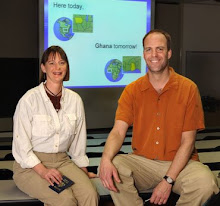
Pictured: A few of the latest from Ghana to obtain the rank of RPCV


I dug into my stash of blogspot drafts this week and pulled out this one:
 Inside the boys' dorm privy
After my tours of Southeast Asia I was a little concerned that when I came to Ghana I might be dealing with a potentially tedious “potty” situation for 27 months. I was relieved to learn, however, that a toilet in Ghana very closely resembles our American toilet. Thankfully, my preparations in moving to Ghana did NOT have to include daily workouts of thigh-numbing squat exercises.
Having said this, however, there are certainly differences in the types and availability of facilities. Water is a precious commodity, and most people in Ghana have to haul their daily water supply from the local well or bore hole. The water source may be a 20 minute trek one way. And as you might imagine, carrying a large container of water on one’s head, up a hill, under the African sun, can be a workout. So with the lack of conveniently piped water, there are more urinals and pit toilets in Ghana than flush toilets.
 School urinal (with designated areas for boys on one side, girls on the other side, and teachers in the middle)
I have learned some things about water consumption in the time that I have been living here. First, it’s amazing how much water it takes to flush a toilet! Second, it takes much less effort to collect rain water from a roof than it does to pull buckets of water from a well. Third, conservation.
Do you remember when you used to leave the faucet run all the while that you brushed your teeth? (I hope none of you do that anymore). To me it now seems equally ridiculous to do this when you shower! I can take a very respectable bucket bath with less than 1/3 the amount of water it takes to flush just once. And when we have running water for a shower I can use even less. If you are one of those people who are now in shock due to your knowledge of my showering habits in a “former life”, please take this moment to pick your jaw up from the floor. I’m serious! Admittedly it may also be that my new behavior is encouraged by our lack of a hot water heater. But I’m hoping to take my water conserving habits home with me nonetheless.
A great experiment for the American public would be for everyone to haul their own water for just a few days. I’ll bet our water consumption (or water waste) would plummet as a result.
 Primary and junior high students hauled water to mix cement for a new building addition. The small stream is over ¼ mile away.
Back to toilets-
- Pit toilets-common
- Flush toilets-not necessarily uncommon unless you are traveling and really need to find one
- Urinals-hmmm
Until I moved to Ghana, I did not know that women use urinals. The urinals here are typically flat cement slabs (or bare ground) with ¾ height partitions around the sides. Some have a men’s side and a women’s side. Some are unisex. But it doesn’t matter because all are constructed the same way – just a cement slab with a hole that opens to the outside at the base of one wall. That’s it. They vary a little bit. Sometimes the “privacy” partitions are cement and sometimes plywood or woven palm fronds. And sometimes the really fancy ones have a shallow trough built into the floor to help guide the yellow river to the drain hole. Regardless, you don’t normally want to be downwind from these “structures” on a hot day and suffice it to say that washing of shoes is a regular chore in Ghana.

Another girls' room on campus
 Inside a newer urinalI’ve learned to fast on travel days and am in awe of myself that I can go all day without a potty stop. On long tro-tro rides, sometimes other passengers will request a pit stop at which point the driver will pull to the side and a few people jump out and relieve themselves roadside. I’ve seen more johnsons in Ghana alone than I thought I’d ever see in a lifetime. And No, it’s NOT because I’m trying to look. In fact it’s hard to avoid catching a glimpse when you are surrounded by so many free-ranging wankies.
 Fellow PCV, Toby, steps a few feet away from our table to relieve himself in the "privacy" of the establishment’s urinal.
Of course it’s easy for the men. But I’ve also seen some women that have adapted to the difficult circumstances. I am here to tell you that some Ghanaian women can pee standing up! Once I got over the initial shock of seeing that maneuver, I found it to be enviable. But for so many reasons I’m not about to try it myself.

A word you hear quite often maybe too often here is “somehow.” It is used during discussions about the progress of something or the hopes of progress; “The computer lab will be finished by God’s grace…somehow.” “The government will by all means get us the monies they owe us…somehow.” I believe it is more of a disclaimer or optimistic version of “or maybe not.” Sadly too often discussions on progress and development end with “somehow.” (By the way neither has happened yet. It may, somehow…someday.) Our hope for the futureBUT! Yes but I have swung back into the optimist’s camp and I see hope for things here. Why? Well as often as I hear “somehow,” I hear phrases like “I know” and “We want to do it.” And I hear less and less, “Will you do it for us?” and more “how can we help?” This is a small step but very exciting! Far too long I have stewed in anger after watching Ghanaians accept their place and not hoping for better. I was overlooking the ones who were saying, “Enough already, let’s change things, let’s take control of our destinies.”The major project I am unveiling this year at school is The Campus Pride Initiative. I happened upon its new motto at the first Sunday church service at school this past week. Rev. Kwarteng gave a sermon on making a difference, something the students needed and I really needed. I took a bit of poetic license and have decided the Campus Pride Initiative will have the motto; Effect Positive Change. I hope that it will have an effect on just a few and that effect in turn will go far beyond DASHS. I want these students to have hope, to be the change agents that Ghana so desperately needs.
 More hopeAnyway I really want to talk about a couple of stories we heard recently, one on BBC and one on NPR. The BBC story was called “Why is Africa Poor?” and the more Tammi and I listened, the more spot on we felt they were with their observations. As I have said before one of the amazing things about Peace Corps is we are here for over two years which grants us the ability to get a real sense of what is happening in a place though I could never say we can completely understand, our context just does not work here. It is very important to remember this when considering how to “help.” We have seen too often when a well meaning NGO drops in, shells out a bunch of money, maybe puts up a building or two and then leaves without ever spending the time to find out what or where the real need is. I would argue the most important need is “ownership.” People need to be able to say, “I worked for this.” or “I earned that.” These phrases are used far too little here and when they are sadly it is the corrupt politicians and civil servants justifying their chopping (skimming off the top for themselves) of budgets. One of the best lines from the BBC story states, “Africa is not poor, it is poorly managed.” I find this to sadly be so very true. As I see it, we well meaning people and governments of the west have created a continent of aid junkies who believe that someone else will do it for them, and that they will be taken care of no matter what. The heartening thing is that most of the people here we have spoken with realize this and recognize that it isn’t good. But just like drug addiction it isn't that easy to kick the habit especially when western governments and companies continue to profit from the addiction.
 Ghana's future military...We stay in a region called Afram Plains and I would guess it is about the size of two or three counties in Iowa, around 500 square miles. The US Government under the guise of the Millennium Challenge Account has put almost $250 million into the development of Afram Plains via the Ghanaian Government. After everyone is finished dipping their hands in the jar it is hard to see a single change for the better here. One now sees is a new fleet of pickup trucks with the MCA logo on their doors and a nice new half empty building in Donkorkrom which houses a few of their offices complete with air conditioning throughout! Imagine if 250 million dollars was spent on 3 rural counties in Iowa.Anyway it is very easy to be angry and jaded but I know that there is hope, great hope and I remain angry but not jaded. The folks around here want to see change. They want to see a better future for their children, and they love their country. They simply do not know how to do it or they feel powerless and sadly it breeds complacency. In my humble opinion what they need from us is more Peace Corps or something like it and less throwing of guilt money at the problems. They need assistance, good education and training, and friendship, not more money. We need to oversee/guide not do. We cannot continue to come to the rescue every time someone breaks a nail. Teach them to mend it themselves. For example, I see far too many bits and pieces of perfectly good road machinery lying along the unfinished road from here to Etche because something broke down. And from experience, if something goes wrong the “obruni” (white man) will come and give them a replacement. Why not? After all, we bought the machinery to begin with. If we want to truly help, we need to continue and expand the Peace Corps style model. A model where assistants integrate into the community as much as possible and are make the time to identify what really needs to be done. Then provide assistance. Don’t do it for them.
 ...or maybe notI have come to see the people in my community as friends and family, not a project. And I will very much miss them when we leave in some ten months. I have come to truly care. I go as far as saying I have come to really love these people and I pray for only the best for them. If you want to help, encourage our government to not only continue but enlarge the Peace Corps. And when giving money to any development organization, look closely at how those organizations function. The Peace Corps is not perfect and there is plenty of room for improvement. But I think that when JFK and General Shriver conceived of this brilliant idea almost 50 years ago, they were really on to something.A great challenge for us is that our view of the world is tied to our own context. For instance, how do we define poor? I can say with confidence it is not the same as how Ghanaians would define it. The other night Tammi and I were on a walk and decided to see what was down a trail that went off the main road. We came to a clean attractive little area surrounded by plantain and banana trees and a tidy little mud walled hut with no running water or electricity. There was a friendly woman with her healthy happy children, including one of the more pleasant young ladies I have ever met who attends the JHS just down the road. Are they poor? Why? What more do they need?
 Most beautiful smile in the world!I can’t help to think that there are far worse situations in the world. Shouldn’t the aid go to those situations? Or better yet, be directed to prevention of those situations instead of playing triage. We cannot continue to apply our western sensibilities to the issues over here. We simply must take the time to develop relationships that will help us to gain the understanding needed to make better decisions about international aid.There are three directives to the Peace Corps mission. One is “to educate the host country’s people about the people of America.” There recently was a group from Scotland visiting and helping at the school. We were told that there was a very negative image of Americans in Scotland and getting to know us they were surprised how different we were from their preconceived perception. I trust I don’t need to go there… Ok I will, “Bush loving war mongers.” I know they weren’t Ghanaians but it really illustrates the point. I hope that we are having the same effect on our Ghanaian friends and colleagues.Please listen to these podcasts and let me know what you think. It is important for the peoples of Africa that we shift our thinking toward aid. APR’s Speaking of Faith; “Ethics of Aid” http://speakingoffaith.publicradio.org/programs/2009/ethicsofaid-kenya/ BBC: “Why is Africa Poor?” Part 1: http://www.bbc.co.uk/programmes/p003zt3qI feel the most important thing you need to take especially from the BBC series is at the end of the day the people not just here but everywhere need to do for themselves. We all want ownership of something and the pride that goes with it.
So somehow we WILL get it done. We ALL will get it done…somehow.I look forward to continuing this conversation…

Sometimes I wonder how often in the course of African history, peoples’ lives have changed after a meeting of minds under a mango tree. It may seem quite insignificant in the greater scheme of things, but this week our neighborhood women’s group gathered together to learn about family planning.

For the past few months my friend and fellow faculty member, Gifty, and I have been going around visiting the homes of women in our area. We have been learning a little bit about the ladies, their families, what they enjoy in life, and what is difficult for them. We listen for things that make each woman unique and we listen for things that they have in common. The first common issue that bubbled to the surface of our conversations was family planning. The ladies wished to learn more. So with Gifty’s connections at the hospital, our first group meeting was arranged.

Two representatives came from the hospital’s family planning center and provided information regarding the use, benefits, and drawbacks of all types of birth control from implants and IUD’s to the rhythm method and how breast feeding technique can affect fertility. I thought I was fairly knowledgeable on the subject, but even I learned something despite the fact that the whole presentation was in Twi.

Personally, I have really enjoyed this women’s group project and I’ve been hoping that I’m not the only one benefiting. So after the meeting when the group asked with anticipation “Can we have another event like this next month?” my spirits flew to the highest branches of the mango tree.
To be continued...