Tuesday, October 21, 2008

"Chopper Soccer" by Tammi; 21 Oct 2008


I find that when a helicopter lands on the school football field (a.k.a. soccer) it causes a bit of class disruption. It even disrupts the grade school and junior high school down the road. And it seems that some folks from town (about 1 ½ miles away) also feel it’s worth the cost of a ride down to our school to see the big chopper land and take off. Everybody wants to come and see (including Chris and I). This is what happened today-three times! I was told that the government helicopter was bringing and picking up forms for the new national identification program which is being implemented in Ghana. But who knows…I’m ignorant and confused about what's going on around me here most of the time.


Chris investigates


A few spectators gather


Chris's visual arts students

Sunday, October 12, 2008

"Indoor Fauna" by Tammi; 12 Oct 2008

I am beginning to think of Raid as air freshener. As I sit here typing, I see there is a trail of tiny red ants coming from somewhere around the window and going to destinations unknown. Since I see them so frequently, I often wonder what these small annoyances do for a living. I’m not sure if they have a taste for sweets, mold, “meat”, moisture or if they simply just want to get into things-everything! Regardless of their career choice, I am plotting my next attack with my trusty “All Purpose Insect Killer” in the pretty purple can.

When we came to Ghana the first house-dwelling creature of that I observed was the very fast, often times large, flat, wall spider. While it looked creepy, we were told that spiders in Ghana don’t bite so we warmed up to them a little bit. In fact I named one of our larger wall spiders George. One day George seemingly disappeared. It was shortly thereafter (coincidentally?) that I noticed the gecko that had come to live with us. I felt it was only appropriate to name it George II.


The red ants march on, the occasional wasp makes its way in, gnats fling themselves at our light bulbs, an occasional termite drops by, and various other 6- and 8- legged creatures come and go. But I am happy to report the complete absence of cockroach sightings in our own home. We are careful to stow and secure our edibles in the “keep” in hopes that this will remain the status quo. As far as the little malaria-carrying-biting-bastard-mosquitoes, we have found that they are less prevalent here than in Iowa on a typical summer day. Rarely do we see one in the house.

Some of our fellow volunteers are not so fortunate. Home invasions of various degrees of have been reported. Their lists include scorpions, bats, mice, and snakes. So (happily) our indoor fauna is fairly boring.


Overall, bugs are not as problematic as I had anticipated. Regardless, I periodically engage in chemical warfare. While I make a point to avoid any geckos and I do not aim directly at the spiders, (they are on our side after all), I take responsibility for accidental casualties of war. I also understand that there may be possible human side effects if I use my weapon too often, too liberally, or too carelessly. Whatever-gotta go Raid the northeast border!

Sunday, October 5, 2008

"Daily Grind" by Tammi; 05 Oct 2008

I believe it would be all but impossible to find a Peace Corps volunteer who did not think it from time to time. But last week is the first time that Chris or I said it out loud. Maybe it is because the thought is less threatening than it was earlier in our service and the difference between saying it and actually acting on it is now separated by a much safer margin than it used to be. “Of course I think about it”, I answered. “It crosses my mind nearly every day”. But as we casually discussed the sinful thoughts we all share of getting the heck out of here, I think we also stabilized our commitment to fulfilling our volunteer pledge in full.

Not surprisingly, life in a foreign land is challenging. Those who have lived
abroad can tell you the difficulty of…well…EVERYTHING. I’m not just talking about a new home, a new job, a new language, new culture, and new environment. I’m talking about the (formerly) simple things that we do every day. Eating, drinking, bathing, sleeping, shopping, and commuting, and so on. It all takes a heightened level of energy to complete the common tasks, and for each task it takes a while to work up enough gumption to get the job started.

Our presence here falls somewhere between freak show and movie stars. It is impossible to step foot outside of our home compound without being called to, stared at, carefully ignored, or enthusiastically greeted by each and every passerby. Every small child craves a wave from the passing “obruni” (white person). And the children with greater vocabulary commonly ask for money (since it is assumed that all obunis are wealthy).


Combine the lack of anonymity and daily challenges with the heat and humidity and you find that the daily grind can really suck the energy out of you.

On the other hand, the daily grind makes the actual work feel like a welcome distraction. It’s fun to consider the possibilities of an eco lodge/artist community/national park tourism when it takes your mind off the fact that you have a pile of super stinky clothes in the corner that must be washed but the electric is down, the water pipes are only trickling, and maybe you shouldn’t wash anyway because it looks like it’s going to rain.

As an escape, Chris and I have always enjoyed going out for walks, bike rides, and generally getting out and exploring. Here, (once we psyche ourselves up enough to go beyond the gate), we typically assign a certain amount of time to our outings, “Let’s go down this path for 45 minutes and then turn around and come back”. Inevitably, when the allotted time is finished one of us will say “Let’s just go up around the next corner to see what’s there”, or “Let’s just keep going to the top of that hill so we can see what’s on the other side”.

Now, as we continue our Peace Corps Odyssey, I am guessing that both our commitment and curiosity will carry us through. Sure it takes some added energy, but it’s just too darn intriguing to discover what lies around the next bend!


Saturday, September 20, 2008

“About School” By Tammi; 19 Sept, 2008


School officially started on Monday, although it's kind of hard to tell. Today is Friday. No classes have been held yet. Only about 1/6th of the students have reported to our school. High school fees are about $75/term, (there are 3 terms), and many students will not be able to afford fees until the beginning of next month. Few of the first year students know which school to report to. The Ghana Education System (G.E.S.) is just now sending out the high school entrance test results and school assignments. Most high school students in Ghana are boarders and live on the school campus. Students typically have to travel 1-2 days to reach the school where they board.


Entrance to school campus

The students who have reported to school have spent their first week cleaning, sweeping out the classrooms, and “weeding” (mowing the lawn with machetes). Our school is very typical of schools in Ghana.


Just your typical school girls

The assistant headmasters started working on the class schedule yesterday. Before the class schedule can actually be developed, however, the masters need to know how many teachers are returning, the subject(s) they teach, and how many students are coming. These items of input are still quite vague.


Chris and Assistant Headmaster/art teacher, Mr. ABC

I have been assigned to teach Information and Communications Technology (ICT) to freshman and sophomores. Today I was issued a box of chalk, 1 red pen, 1 blue pen, and a notebook to write my lesson plans in. I have a textbook which I tracked down and purchased in Accra, a photo copy of the freshman syllabus which was provided by the Peace Corps, (the sophomore syllabus has not come out yet), and some misc electronic files that I have collected from other teachers. Yep, that should pretty much ensure my teaching success.


classroom block

We have a new school computer lab! However, said lab has been under construction for nearly 2 years (as are the admin offices, boys’ dorm, girls’ dorm, new classroom block, old classroom block, and assembly hall). The construction crew is supposed to be returning to work “any day now”. There are about 20 misc disassembled computers in various states of disrepair in a dirty (infested?) store room. If the school electrician is able to install electrical outlets in one of the designated classrooms today, I will be able to start setting up and testing the functionality of the computers over the weekend. The typical class size is 40-60 students. So if we are lucky enough to get most of the computers operational then each computer will have 3-4 students trying to use it during class. Last year G.E.S. promised 40 new computers to each high school. I’m guessing that these computers will actually reach our school sometime after the missing construction crew completes the campus building projects.


New computer building under construction (complete with sheep on porch)

Our fellow teachers and staff at the school have been delightful! The atmosphere of the school is very positive and the school seems to have a fine reputation. We are sad that our headmaster/neighbor will be moving in a week or two. But apparently being transferred goes with the territory as headmasters are transferred about every 5 years. We have grown quite fond of Headmaster Daniel and his family and are hopeful that the new headmaster and family will be as likeable.


Outgoing Headmaster Daniel with wife Madam Tina

“Our Home” By Chris- 13 Sept 2008


Out for a walk


OK so I would love to say we are living in the bush of Africa taking turns at night beating off poisonous snakes and insects while the other tries to sleep but I can't. Don't get me wrong there are poisonous snakes including Cobras and Mombas, dangerous millipedes, and scorpions that sooner kill you then look at you. All big fun but we aren't living in a thatched hut sleeping on dirt floors, we live in what was/is the guest apartment attached to the back of the headmaster's house. It originally was a house built by Japan Motorworks to house an executive that was overseeing a tractor works that didn’t pan out. We have 24/7 security guards, though I question what these guys (who are very nice people) would do it confronted with any sort of danger.


The Headmaster's house is in the front. You can see our little abode sticking out on the back left.


The "hall" (living room)

Anyway we have 2 bedrooms, a living room (what they call a hall), a kitchen, a storeroom/pantry, a shower room, and toilet. We share it all with a myriad of innocuous bugs and spiders and several geckos who are a lot of fun to watch scurry around. It is not Shangri-La by any means but it is more than adequate. WE EVEN HAVE A TV! They were so excited to show us our TV and its one channel. We do try to catch the news on occasion but it is rarely turned on for I was looking forward to being away from TV after my serious TV addiction issues back in the states. We are far more excited to have a fridge, a cold beverage in Africa is a precious commodity. We had to buy a gas cooktop and a kitchen sink, we also had a carpenter make tables for the kitchen. I know what you’re thinking; why didn't I make them? Well I didn’t bring tools I haven't quite figured out how to track down materials or tools and until then there's a need and besides they were quite cheap. One table a 36"x 60"x 20" table made of all hardwood, all be it still wet (I think it’s Kapock wood) cost us the equivalent of $25.00. I do plan on making us some furniture as soon as I can track down some tools. I also hope to be doing some sculpture of which I already have some drawings of. I will keep you all apprised of my creative ventures.


"Automatic Washing Mashine"


"Coffee Grinder" (We are grateful for the beans sent from the States)!

We are in a pretty rural area of Ghana as I discussed earlier and it is not easy to find a lot of things in the market here, but a wise person said to me before we left the states, "When you start thinking you can't survive with what's available, look around and realize that these people have survived with far less for a very long time." Bottom line is we have everything we NEED, everything else is a luxury and to me sometimes it seems we are living in luxury comparatively…


The road between our home and town


Another pretty sunset from our doorstep

"Our Site" by Chris: 12 Sept '08

Here we are the swearing In Ceremony


We have been at site now for a little over 3 weeks having sworn in as actual Peace Corps volunteers on the 19th of August. Training was intense for someone who has not been on the learning end of a classroom situation in a very long time. I would say the language was the most difficult thing for me while Tammi had a little easier time of it. We were also required to pass a language competency test before we could be sworn in. I was truly terrified of it but passed on my first try and so did Tammi.


Our Twi language learning group -and - The now "famous" drumming troup

So here we are at site, in Donkorkrom, sometimes spelled Odonkawkram or Odonkawkrom. We just learned that it means "Slave Town". Donko is Twi for slave and Krom means town. I won't go into the history of the area just now. I also won't repeat all the statistics about Donkorkrom, just some observations;

Some call the Afram Plains, (of which Donkorkrom is the "capital"), the bread basket of Ghana. Back in the early 60's a dam was built on the Volta River or in the local language Esuten Frau and with the damming of the river system it flooded not only the Volta River to our east but also the Afram River (Esuten Afram) to the west and now Afrom Plains is virtually surrounded by water. Before the valleys were flooded this was a major cocoa growing region and after the flooding the climate was changed, the cocoa trees could no longer thrive and they died. 40 plus years later the Afram Plains has switched over to other crops including Yams (bayera) cocoa yams (mankane), casava (banchae) and maize. Most farming is done on a subsistence basis growing just enough to feed their families plus enough to sell at market to make a living. Some have tried larger scale agriculture but there is still a lot of work to be done there. Probably the largest export as well as largest environmental problem in Afram Plains is charcoal. Trees are being taken down at a dizzying rate to be made into charcoal. The government has tried to get the charcoal makers to at least replant the trees but they presently see little sense in that when there seems to be plenty of trees to cut down. They seem to have something in common with us westerners; shortsightedness. Traditions and people’s minds are very slow to change here, also something they have in common with us. So if any one has any brilliant suggestions...


Loading the pontoon for river crossing to Afram Plains

Our school sets on a one square mile piece of property but the actual school takes up a very small part of that. They along with several other places in Afram have planted plantations of Teak and Mahogany which offers a wonderful amount of shade on campus and potential profit generation for the future. They are thinking long-term which suggests the school is well run. Though as with a lot of things in Ghana it is by no means a well oiled machine;

Our school was to begin Monday Sept. 15th but no one is quite sure how many students will show up or even how many teachers will return for the next school year. Its run a bit differently here than what we're use to. We are told students will trickle in for the next couple of weeks, and the form 1's (freshmen) will show up quite a bit later. School is based on a 3 term school year. We will find out what we are actually teaching and when and classes will start in earnest by say the week of the 22nd. We call it GMT no not Greenwich Mean Time but Ghana Maybe Time. Everyone we have interacted with at school has been wonderful. They are as anxious to learn about the US as we are to learn about Ghana. Our head master is first class and sadly we are losing him and his family to a lucky school in the Kwaho Mountains. We hope that our new head person will be as good.

A Note from Tammi: You may have noticed that it's been a while since our last posting. We have been "recovering" from a hard drive crash, which is something that is hard enough to deal with when you live in a 1st world country! Anyway, we're back up. Sorry for the delay...

Thursday, July 17, 2008

Wow! We Live in Africa! July 7, 2008


In our first 24 hours in Ghana we were greeted at the airport by a band of whooping Peace Corps reps, received a police escort to our first training site, had our arms injected with various vaccines, learned a little Twi (the local language), met with the Minister of Education, and attended a reception at the ambassador’s house. Then…things got busy.


Currently we are in what is called Pre-Service Training (PST). We trainees are living with host families in the communities near our training hub. The training hub is in the village of Kukurantumi , which is near the town of Koforidua in the Easter Region. Our days are filled with language learning, teaching practicum, and community integration activities.

We are currently in the rainy season. It rains almost daily for an hour or two – at times very heavy. Temperatures are in the 80’s. This is a fairly affluent part of Ghana. Not all locations have them, but ceiling fans provide a good level of comfort. Chris and I feel quite fortunate to have a fan in our bedroom. Here we have electricity most of the time. We had indoor running water for our first 4 days, but for reasons unknown (possibly repair or construction) the piped water has stopped. Our host family collects rain water in barrels which we use for cleaning and bucket baths. They also fetch water from the nearby bore hole which we use for cooking and drinking. Peace Corps provides volunteers with an easy to use, gravity fed ceramic water filter which we use to treat all of our drinking water. This helps to prevent a myriad of very “interesting” potential ailments. Despite the precautions taken with food and water, it is possible that we will not experience our next normal bowel movement until we return to the States in a couple of years. Peace Corps Volunteers (PCV’s) and retired people are similar. We both live on fixed incomes and we love to talk about bowel movements.

Chris and I really enjoy our training group. Our group of trainees is quite unique for two reasons. First, there are two couples in the group (Chris and I being the elder couple). Second, at age 84 we have the oldest Peace Corps Trainee (PCT) to date as part of our group! Peace Corps life is not easy. It wears down the young and old alike. We started in Philadelphia with 35 trainees. Two have already returned home. Chris and I feel that the couples are at an advantage since we have our own built-in support system. We are impressed at the tenacity and adaptability of our counterparts.

After MUCH anticipation, we have received our site assignment where we will spend our 2 years of service beginning mid-August: Donkorkrom.
I’m sure that the fact that we are a couple went into our site selection. It’s kind of in the middle of nowhere. We have to take a boat to get to it! I anticipate that it will take a full day of travel to reach our site from our present location and/or from the capital city of Accra. Donkorkrom is in the Afram Plains of the Eastern Region. It is a multi-ethnic society made up mostly of farmers, traders and a few Government workers. The district is said to have a vibrant and fast growing market. Donkorkrom has pipe born and borehole water that supplies the whole township. Electricity supply is from the national grid. As is common, the community is headed by a chief.
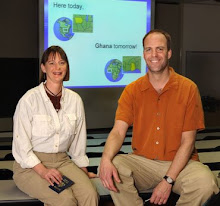
We will teach at Donkorkrom Agric Senior High School (DASS). DASS is located on approx 1 square mile of land with an enrolment of about 700. The school offers programs in Agriculture, Science, Business, General Arts and Visual Arts. Dormitories and classrooms comprise the campus. Apparently the school has about 20 computers. I do not yet know how many of them are actually functional. We will visit our site the first week in August.
Our living accommodations are described as a flat which is located about 50 meters from the school. There is a toilet and bath facilities and electricity. (Of course we do not yet know how reliable any of those utilities are).

Donkorkrom is of note as the southern administrative center for Ghana’s second-largest conservation area Digya National Park, which extends over 3,750 square km north of the Afram Plains and west of Lake Volta. According to Ghana Bradt Guide, Digya has never formally opened to the public due to difficulty of access, but its potential is enormous thanks to a remarkable diversity of habitats and a mammal checklist that includes red-flanked duiker, elephant, manatee, hippopotamus, buffalo, lion, leopard, bongo antelope, and half a dozen species of monkey. The Dowsetts recorded 236 bird species over a 9-day expedition in 2005 and a checklist of 300-plus seems probable.

We arrived in Ghana on June 10th. This is my first in-country blog posting because this is the first time I have had access to the internet. The internet café is located about 6 km away from where we are staying. Travel is always a bit of an adventure. And the first 3 times I attempted to use the café it was either closed or the internet was down. We are still working out how best to stay in touch and are looking into connectivity options. For the first time, however, Chris and I both have cell phones. I guess it took moving to Ghana to get that accomplished. I’ll be happy to share our phone numbers with friends and family if you zap me an email. Just be sure to keep the time difference in mind. Ghana is on Greenwich Mean Time (GMT), which is currently 5 hours ahead of CST. Ghana does not recognize daylight savings time.
Well I better get back to making lesson plans for my practicum teaching. Next week I am teaching follow-up lessons to the HIV/Aids and internet classes I taught at the local senior secondary school this week.

Observation of the day:
I was sitting in on an ICT class at the local high school. Without the aid of computers, the teacher lectured on how to set up an email account to 45 dark skinned students who had never even seen the internet function. With chalk and a well-worn blackboard, he wrote out the steps. A woman dressed in a pretty batik pattern dress passed by along the path leading to the back gate. With perfect posture, she easily carried a bowl full of porridge sachets on her head. As the teacher continued his lecture a chicken casually entered the doorway on one side of the room, and then pecked her way across picking up tidbits and little broken pieces of chalk before nonchalantly exiting through the other doorway. In the distance a kid goat bleated for its mother. A nice breeze kicked in, cooled the layer of sweat on my skin, and brought the first few drops of rain. Soon the rain was pouring down with such force on the un-insulated tin roof that the teacher’s voice became inaudible. Thus, the teaching paused. But nobody seemed bothered by it. After all, we’re on GMT (Ghana Maybe Time).
And I thought to myself – Wow, I live in Africa!